


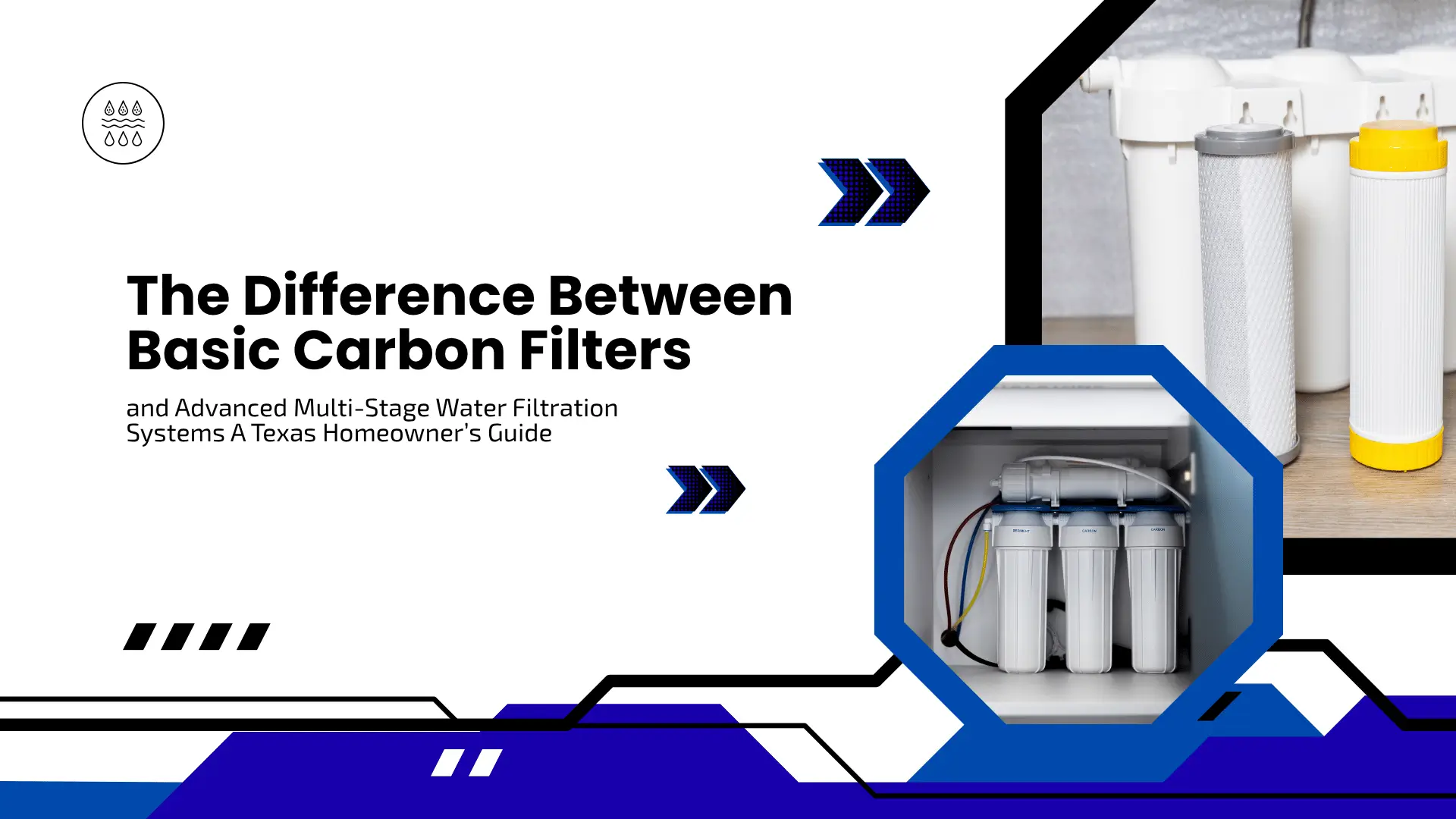
If you’re a homeowner in Texas, you’ve probably noticed that not all water tastes the same. Depending on whether you live in Houston, Sugar Land, Katy, San Antonio, or Austin, your tap water can range from slightly chlorinated to downright hard. But when it comes to filtering it, the choices can be overwhelming. On one hand, you have basic carbon filtersthe kind you might screw onto a faucet or drop into a pitcher. On the other, you have advanced multi-stage whole-home systems that sound like something out of a science lab.
So, what’s the actual difference? And more importantly, what does your family actually need? Let’s break it down in plain Texas English.
What Basic Carbon Filters Actually Do
Most basic water filterswhether they’re in a pitcher, a faucet attachment, or an under-sink single-stage unituse activated carbon. This is a form of carbon that’s been treated to have an enormous surface area, allowing it to trap contaminants as water passes through.
A standard carbon filter is great at improving taste and odor. If your biggest complaint about your tap water is that it smells like a swimming pool, a basic carbon filter will help. It reduces chlorine, sulfur compounds, and some volatile organic compounds (VOCs) that make water taste funny. You can think of it as the entry-level solution for making water more drinkable.
But here’s the catch: carbon filters have limits. They don’t do much against dissolved minerals, which means they won’t soften hard water. They also can’t remove heavy metals like lead or arsenic effectively, and they’re notoriously weak against fluoride and chloraminesa common disinfectant used in many Texas municipal water systems. Basic carbon filters remove less than 10% of fluoride in most cases, for instance .
Furthermore, basic carbon filters have shorter lifespans. A typical pitcher filter might last two to three months before it starts losing effectiveness . Once the carbon is saturated, it can’t trap anything else, and in some cases, it can even release trapped contaminants back into your water.
How Multi-Stage Systems Go Much Further
Advanced multi-stage filtration systems are a whole different animal. Instead of one single carbon cartridge, these systems use multiple stages of filtration, each designed to handle different contaminants. A typical setup might include a sediment pre-filter, an activated carbon stage, a reverse osmosis membrane, and a post-filter to polish the water.
Here’s how that works in practice:
- Stage 1 – Sediment Filter: Water first passes through a sediment filter that traps rust, dirt, sand, and other physical particles. This protects the more sensitive filters downstream.
- Stage 2 – Carbon Filter: This removes chlorine, chloramines, and organic compounds.
- Stage 3 – Reverse Osmosis Membrane: This is where the heavy lifting happens. The RO membrane forces water through a semi-permeable barrier that removes up to 99% of dissolved solids, including lead, arsenic, nitrates, and fluoride .
- Stage 4 – Post-Filter (Polishing): After passing through the storage tank, water goes through a final carbon filter to improve taste and ensure nothing leached from the tank.
In some systems, you might also have a remineralization stage that adds back healthy minerals for better taste. But the point is clear: multi-stage systems don’t just mask problems; they actually remove them.
Whole-Home Filtration vs. Point-of-Use
It’s important to distinguish between under-sink multi-stage systems and whole-home water filtration systems. An under-sink RO system treats just the water you drink and cook with. A water softener system or whole-house water filtration system treats all the water entering your home.
If you live in a Texas community like Katy, Sugar Land, or San Antonio, you may have heard about water filtration san antonio services or sugar land water treatment services that specifically address local issues like hard water and chlorine byproducts. A whole-home system can protect your appliances from scale buildup while providing filtered water from every tap.
The Contaminant Removal Spectrum
When looking at water softener systems and filtration, it helps to know what you’re dealing with in Texas. The state has a mix of surface water and groundwater. As a result, Texans often face:
- Hard Water: Calcium and magnesium deposits that cause scale on fixtures and reduce appliance efficiency.
- Chlorine and Chloramines: Disinfectants added to municipal supplies that affect taste and can irritate skin.
- Sediment: Sand and silt, especially in areas with older pipes.
- Heavy Metals: Lead and copper that can leach from household plumbing.
- Total Dissolved Solids (TDS): Dissolved minerals and salts affecting taste.
A basic carbon filter addresses chlorine and taste only. A water softener system tackles hardness. But if you want thorough protection, you’ll likely need a combination: a water softener for hardness and a multi-stage reverse osmosis system for drinking water.
For homeowners in San Marcos or Buda, where hard water is notorious, a whole-home water softener system paired with an under-sink RO is often the gold standard. Local aqua pure water softener systems and westinghouse water softener reviews often highlight this dual approach as being most effective for Texas conditions.
Which Type Should You Choose?
If you have municipal water and your main complaint is that your water tastes like chlorine, a basic carbon filter might be enough. It’s cheap, easy to install, and does the job.
However, if you’ve noticed spots on your dishes, dry skin after showers, scale buildup on faucets, or if you simply want the highest quality drinking water, basic carbon won’t cut it. That’s when you need a water filtration system that includes both a water softener for the whole house and a multi-stage RO for your kitchen.
Consider this: a study of water filtration systems shows that advanced multi-stage systems can reduce up to 365 different contaminants, compared to the limited menu a basic carbon filter can handle .
Real-World Considerations for Texas Homeowners
If you’re in Houston, you’re likely dealing with surface water treated with chlorine and chloramines. Chloramines are harder to remove than chlorine, and standard carbon filters often aren’t designed for them. A water softener installation houston or water softener houston tx professional can help you choose a system optimized for your specific water chemistry.
In places like San Antonio, where the water is known to be hard due to the Edwards Aquifer, a whole-home water softener san antonio tx system is nearly essential for extending the life of your water heater and appliances [citation:search]. Meanwhile, water filtration san marcos tx and water treatment san marcos tx specialists frequently recommend multi-stage systems to address both hardness and aesthetic issues.
If you’ve been reading westinghouse water softener reviews or aqua pure water softener feedback, you’ll notice a common thread: homeowners who invest in multi-stage systems are generally much happier with their water quality than those who stick with simple carbon cartridges.
Maintenance Considerations
Basic carbon filters require regular replacement. If you forget to change them, they stop working and can become breeding grounds for bacteria. That’s why it’s important to stay on top of water filtration maintenance.
Multi-stage systems also require maintenance, but typically less often. A whole house water filter might have a sediment pre-filter that needs changing every 3-6 months, with carbon and membrane replacements every 2-5 years depending on use.
For installation, companies like Aqua Pure LLC have certified specialists who can recommend and install the right system for your home, from water softener system installations to whole-home water filtration systems. They often offer water filtration installation and water filtration services, ensuring the job is done correctly.
Frequently Asked Questions
Is a whole-home water purification system worth it in Texas?
Absolutely, especially if you have hard water or concerns about chlorine byproducts. A whole-home system protects your plumbing, prevents scale buildup in appliances, and delivers better water from every tap. For families with sensitive skin or children, the benefits extend beyond just drinking water.
What water issues are common in Texas homes?
Texas water varies widely. Common issues include hard water (particularly in Central Texas near San Marcos and San Antonio), chlorine taste and odor (common in Houston and Dallas), and sediment or heavy metals in older neighborhoods.
Do water softeners remove contaminants?
No, that’s a common misconception. A water softener system exchanges calcium and magnesium ions for sodium or potassium. It removes hardness but doesn’t remove heavy metals, chemicals, or biological contaminants. For drinking water, you need a filtration system alongside your softener.
Is reverse osmosis safe for daily drinking?
Yes, it’s one of the safest options. Reverse osmosis removes virtually all dissolved solids, including harmful contaminants. While some people worry about mineral loss, you can always install a remineralization stage. Many water filtration system experts, including those at Aqua Pure LLC, offer systems with this feature.
How long do home water systems typically last?
A high-quality water softener system can last 10-15 years with proper maintenance. Reverse osmosis membranes typically last 2-5 years, while carbon filters may need replacement every 6-12 months. Sediment pre-filters may need replacement every 3-6 months.
When you’re ready to move beyond basic carbon filtration, the next step is working with a team that understands Texas water. At Aqua Pure LLC, we offer a range of solutions, from water softeners to reverse osmosis systems, to meet the specific needs of Texas homeowners. Contact us today to find the right solution for your home.