


If you live in Sugar Land, Katy, Cypress, or anywhere around the Houston metro, you already know the morning routine can feel like a logistical operation. Someone’s in the shower, the washing machine is running, a teenager is filling a water bottle, and the dishwasher is still finishing up from last night. In a busy Texas household, water demand doesn’t happen in a neat, orderly line. It happens all at once.
That’s exactly why the size of your water filtration system matters more than most homeowners realize. A system that’s undersized for your family’s peak water use won’t just filter less effectively it can leave you standing in a shower with disappointing pressure, waiting forever for the washing machine to fill, or wondering why the kitchen faucet has suddenly turned into a trickle. Let’s walk through what actually happens when sizing goes wrong, and how to think about it like a practical homeowner instead of a plumbing engineer.
The Morning Rush Is the Real Test (Not Your Average Day)
When water treatment professionals talk about sizing, they’re usually looking at flow ratemeasured in gallons per minute, or GPM. This isn’t about how much water your family uses over a whole day. It’s about how much water you need at the exact same moment when everyone is getting ready for work and school .
Think about it this way: a standard showerhead can draw around 2 to 2.5 gallons per minute. A kitchen faucet might add another 1 to 2 GPM. A washing machine cycling on can pull 2 to 3 GPM. If two people are showering while someone rinses breakfast dishes and the washer kicks on, you could easily be asking for 8 to 10 gallons per minute at the same time .
Here’s where sizing gets real. If your whole home water filter is rated for, say, 6 GPM, it becomes a bottleneck. The water can’t pass through the filter media fast enough to keep up with demand. Pressure drops everywhere downstream. Your shower goes weak. The washer takes forever to fill. And you’re left wondering why your expensive filtration system seems to have made things worse instead of better.
A properly sized system has enough flow capacity to handle your busiest fifteen minutes of the day, not just your average hourly use. That’s the difference between a system that quietly does its job and one that becomes a daily frustration.
What Texas Water Does to Undersized Systems (And Why It’s Worse Here)
Sizing isn’t just about pressure. It’s also about what’s in the water. Homes across the Houston area and out toward Magnolia, Tomball, and Cypress deal with a mix of challenges that can punish an undersized filter.
Hard water is the big one. Much of Texas sits on limestone and other mineral-rich geology, and water picks up calcium and magnesium as it moves through the ground and surface sources . Those minerals don’t just create spots on your glasses. They form scale inside pipes, water heaters, and appliances. When water passes through a filter that’s too small, the flow slows down, and slow flow can actually give minerals more opportunity to settle and accumulate. A system that’s constantly struggling to keep up is a system that’s going to clog faster and perform worse over time.
Then there’s chlorine and sediment. Municipal water in the Houston area is treated, but that treatment leaves behind chlorine and chloramine residuals that many homeowners want to reduce for taste and odor reasons. Sedimenttiny particles of dirt, rust, or mineral debrisalso shows up, especially in older neighborhoods or homes on well water out toward Magnolia and surrounding rural areas. A filter that’s undersized has to work harder to capture these contaminants while still trying to maintain flow. It’s a losing battle.
If you’re on well water in the Magnolia area, sizing becomes even more critical. Well water can carry higher levels of sediment, iron, or hardness than municipal supplies, and the filtration system has to be matched not just to your household flow needs but to the specific contaminant load coming out of your well . A one-size-fits-all approach almost never works.
Filtration, Softening, RO, and Sanitization: They’re Not the Same Thing
One of the most common sources of confusionand mis-sizingis treating all water treatment equipment as interchangeable. They’re not. Each type does a specific job, and each has its own sizing considerations.
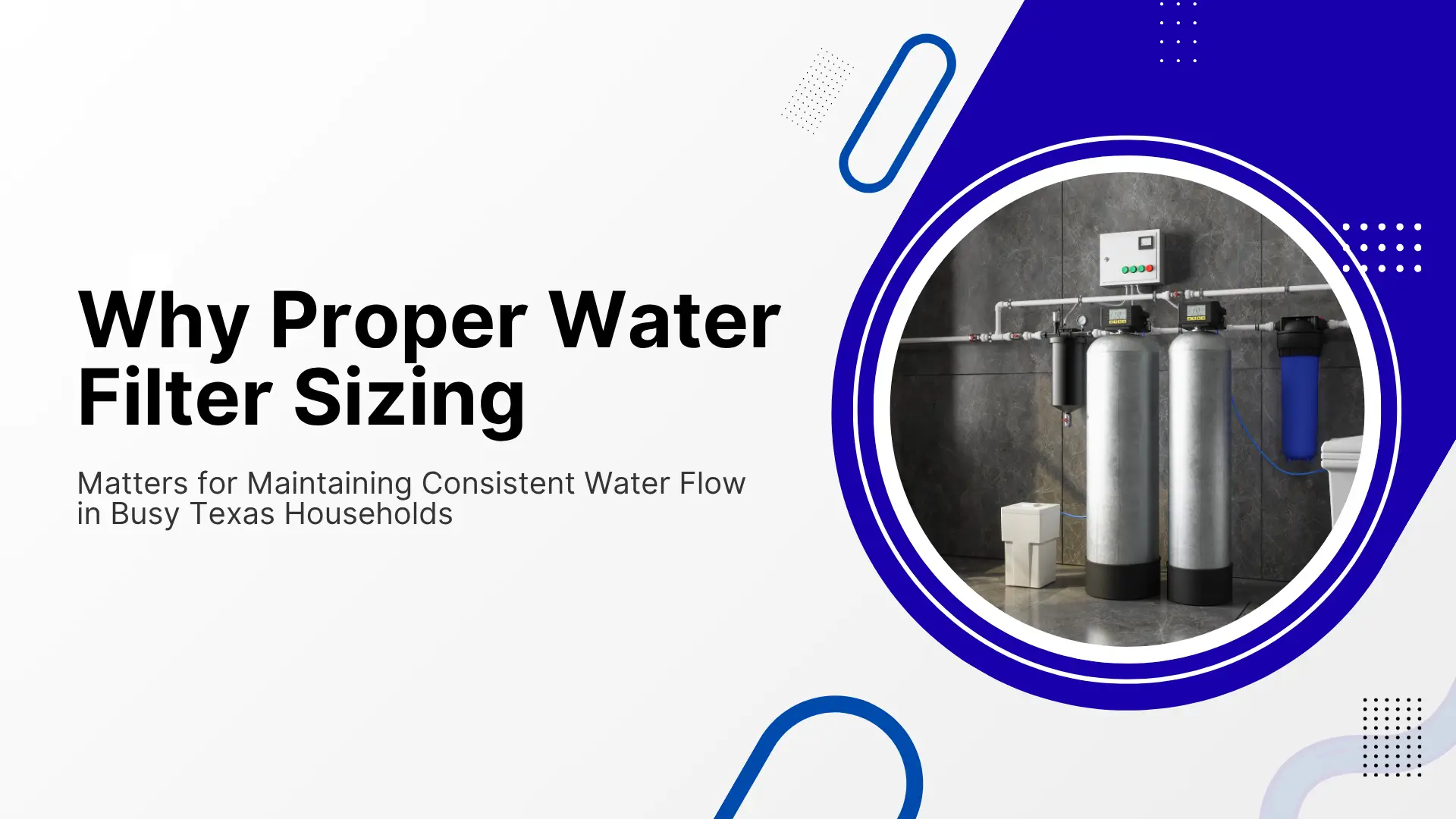
Filtration is about removal. A whole home filter uses physical barriers and media like activated carbon to trap sediment, reduce chlorine, and improve taste and odor throughout the house . Whole home filtration systems are sized by flow rate because they sit on the main water line and every fixture downstream depends on them.
Softening is about chemistry. A water softener uses ion exchange to swap calcium and magnesium for sodium or potassium, which stops scale from forming . Softeners also have flow ratings, and an undersized softener can fail to keep up during heavy use, letting hard water slip through untreated. If you’re in Katy, Sugar Land, or Stafford and dealing with crusty faucets and stiff laundry, a softener is likely part of the conversationbut it needs to be sized for your home’s peak demand, not just square footage.
Reverse osmosis is about precision at the point of use. An RO system typically sits under the kitchen sink and pushes water through a fine membrane to reduce dissolved contaminants like lead, nitrates, and certain PFAS compounds . RO systems are sized differentlyby daily production capacity in gallons per day, plus tank sizebecause they produce water slowly and store it for drinking and cooking . If you’re mainly concerned about what your family drinks, a point-of-use RO makes sense. If you want soft, chlorine-reduced water at every shower and appliance, you need whole home treatment.
Sanitization, often using UV light, is about biological safety. It’s less common in municipal water homes but can be relevant for well water systems where bacteria or other microorganisms are a concern.
The practical takeaway: before anyone talks about brand or price, you need to know what problem you’re solving. A whole home filter won’t fix hard water scale. A softener won’t remove lead. An undersized anything won’t deliver the consistent flow your household expects.
Signs Your Current Setup Isn’t Keeping Up
How do you know if sizing is already a problem in your home? The clues are usually pretty obvious once you start paying attention.
- Pressure drops when multiple fixtures run. If the shower weakens when the washer starts, or the kitchen sink slows when someone flushes a toilet, your system may be restricting flow.
- Water doesn’t feel soft or taste fresh anymore. A filter or softener that’s overloaded or undersized can stop doing its job effectively before it’s technically “broken.”
- Scale comes back quickly. If you softened your water but white crusty buildup returns on faucets within weeks, the system may not be regenerating or flowing properly.
- Appliances take longer. A washing machine that used to fill in a few minutes now takes ten. A water heater that recovers slowly. These are signs that flow or volume isn’t meeting demand.
- Frequent filter replacements. If you’re changing cartridges more often than expected, the system may be too small for your household’s water use or contaminant load.
If any of this sounds familiar, the first step isn’t necessarily a new system. It’s a conversation about what’s actually happening. A water quality test and a flow-rate assessment can tell you whether the issue is sizing, maintenance, or something else entirely.
What “Right-Sized” Actually Looks Like for a Busy Family
Here’s the practical part. Sizing a whole home system isn’t about picking the biggest number on a spec sheet. It’s about matching the system to your household’s realistic peak demand with a little headroom.
Start by counting the fixtures that might run at the same time on a busy morning. Two showers, a kitchen faucet, and a washing machine can easily add up to 8 to 10 GPM . A family of four or five in a home with two or three bathrooms should be looking at systems rated comfortably above that peak, not right at it. Headroom matters because as filters load up with sediment and contaminants over time, flow can degrade slightly. A system that’s barely adequate on day one won’t stay adequate for long.
For RO systems, the math is different. A typical household might use a gallon or two of drinking and cooking water per person per day, plus extra for coffee, ice, and pets. A small under-sink RO with a modest tank can handle that fine. The mistake is expecting a point-of-use RO to supply the whole houseit can’t, and it shouldn’t try.
Maintenance also ties directly to sizing. A properly sized whole home filter might need a sediment pre-filter change every three to six months, with the main carbon media lasting years depending on water quality and usage . An undersized system pushes those filters harder, which means more frequent changes and more cost over time. The upfront savings of a smaller system often disappear in replacement parts and frustration.
Working With Someone Who Knows Texas Water
This is where local experience matters. Water conditions aren’t identical from one side of the Houston metro to the other. A home in Sugar Land on municipal water has different needs than a property in Magnolia on a private well. A newer build in Cypress might have different piping and flow characteristics than an older home in Bellaire or West University.
Aqua Pure LLC is a Texas-based company that works with homeowners across the region on whole home filtration, softeners, reverse osmosis, and sanitization. They’re familiar with the specific mix of hardness, chlorine, sediment, and well water issues that show up in places like Magnolia, Tomball, Cypress, Katy, and Sugar Land . The value of working with a local specialist isn’t just convenienceit’s that the system gets matched to your actual water and your actual household, not a generic recommendation pulled from a national chart.
If you’re comparing options or just trying to figure out why your current setup isn’t delivering consistent flow, a professional assessment can save you from guessing. Aqua Pure LLC offers free water quality testing and works with certified installation, which matters for getting the sizing and setup right from the start.
Questions Homeowners Actually Ask
Is a whole-home water purification system worth it in Sugar Land or Katy?
For many families, yesespecially if you’re dealing with hard water scale, chlorine taste, or sediment. A whole home system treats every tap, shower, and appliance, which a point-of-use filter can’t do. The “worth it” calculation depends on your water quality and what bothers you most. If you’re mainly worried about drinking water, an RO system might be enough. If your showers feel harsh and your appliances are scaling up, whole home softening and filtration make a practical difference.
What water issues are common in Texas homes?
Hardness is the big one across much of the state, thanks to mineral-rich geology. Chlorine and chloramine are common in municipal supplies. Sediment can be an issue in older lines or well systems. Some areas also see concerns about lead from older plumbing or PFAS in source water, though levels vary by utility. The only way to know what’s in your water is to test it.
Do water softeners remove contaminants?
No. A softener is designed to reduce hardness mineralscalcium and magnesiumthrough ion exchange . It doesn’t remove lead, chlorine, sediment, or biological contaminants. That’s why softeners are often paired with filtration if the goal is broader water quality improvement.
Is reverse osmosis safe for daily drinking?
Yes. RO is a well-established technology for reducing dissolved contaminants, and many families use it for all their drinking and cooking water. It does remove some beneficial minerals along with contaminants, but those minerals are easily replaced through diet. For most households, a properly maintained RO system is a safe and practical choice for daily drinking water.
How long do home water systems typically last?
It depends on the type and how well they’re maintained. Sediment filters need replacement every few months. Carbon media in a whole home filter might last several years. Softener resin can last many years with proper care. RO membranes typically last two to three years depending on water quality and usage. The system housings and tanks themselves can last a decade or more. Regular maintenance is the biggest factor in longevity.
A Final Word on Flow and Peace of Mind
If there’s one thing to take away from all this, it’s that water treatment isn’t a “set it and forget it” purchase. Sizing determines whether your system helps or hinders your daily life. A system that’s matched to your household’s real demandyour morning rush, your weekend laundry marathons, your kids’ bath timewill keep pressure steady and water quality consistent. A system that’s too small will remind you of its shortcomings every single day.
If you’re tired of weak showers, spotty dishes, or wondering whether your filter is actually doing anything, it’s worth having someone look at the whole picture. You can reach out to Aqua Pure LLC to talk through your home’s water, your family’s habits, and what a right-sized system would look like for your house. No pressure, no sales pitchjust a clearer understanding of what’s flowing through your taps and why it matters.