


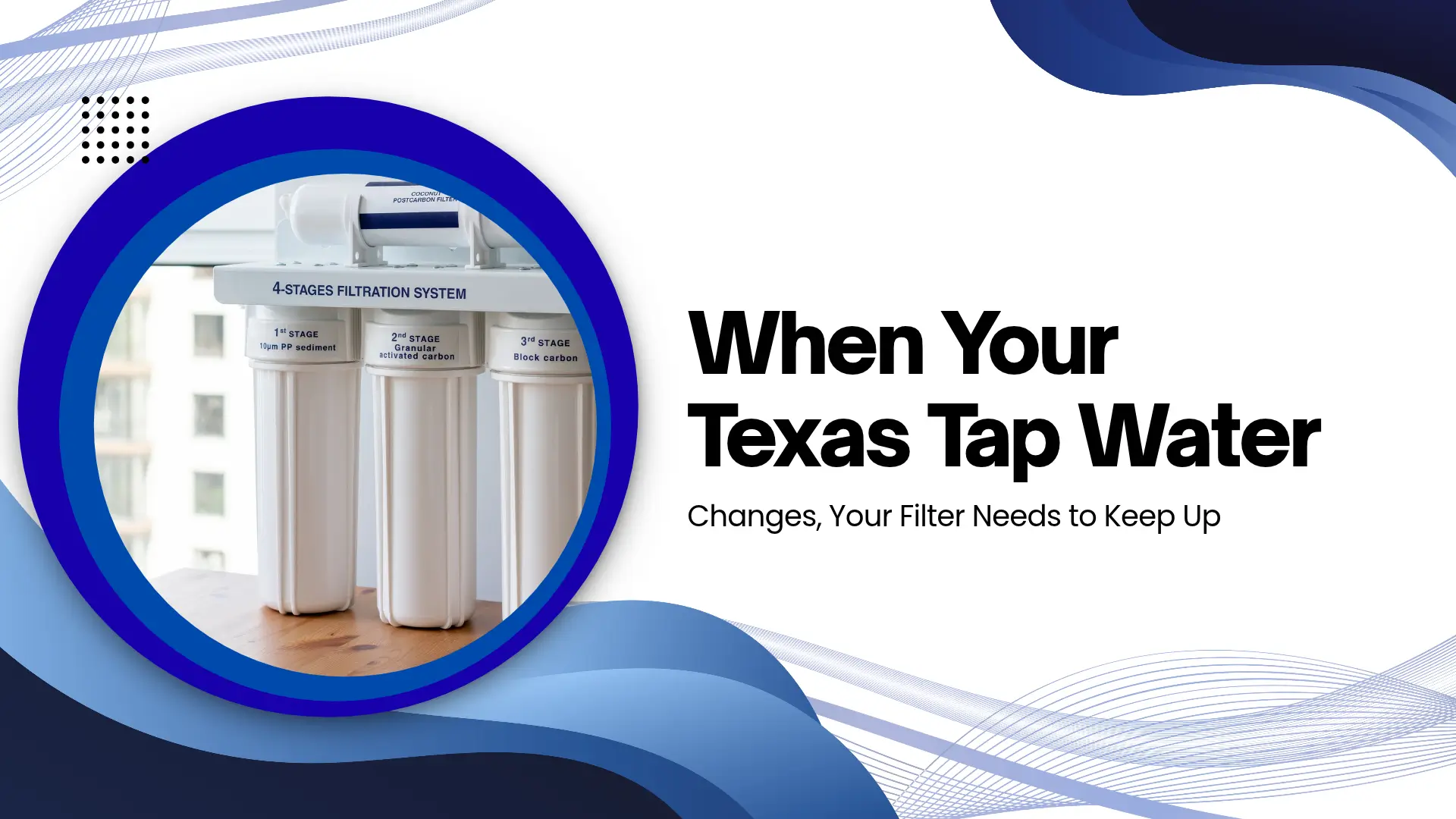
If you live in the Houston metro Sugar Land, Katy, or anywhere along the US-59/I-69 or Grand Parkway corridors you already know our water isn’t static. Depending on which MUD, city system, or utility district serves your street, your water might come from deep underground wells one year and a blend of river water the next. That shift isn’t just a bureaucratic footnote. It changes what’s coming out of your faucet, how it tastes, how it smells, and frankly, what kind of filtration actually makes sense for your home.
I’ve spent enough time in Texas utility rooms and homeowner kitchens to know that “one-size-fits-all” water treatment advice falls apart the moment you cross a county line. Here’s what’s actually happening with our water sources and what it means for the system sitting in your garage or under your sink.
The Big Shift: From Groundwater to River Water (and the Chemistry That Follows)
For decades, many Fort Bend and Harris County communities relied heavily on groundwater pumped from the Chicot and Evangeline aquifers. That water was consistent, mineral-rich, and familiar. But subsidence the sinking of the land forced a reckoning. State mandates pushed utilities to convert to surface water sources like the Brazos River, Lake Houston, and the Trinity River system .
Here’s the practical rub: surface water is biologically active in a way deep groundwater isn’t. It carries different organic material, sediment loads, and microbial risk. To treat it safely, utilities often have to change their disinfection strategy. That’s why you’re seeing a quiet but massive switch across the region from chlorine to chloramine (chlorine mixed with ammonia).
Cinco MUD 5, serving the Cinco Ranch area near Katy, is a perfect example. They’ve announced that starting around June 2026, they’re switching to chloramine disinfection as they transition to surface water from the North Fort Bend Regional Water Authority . Sugar Land’s Main System already uses chloramine, while its smaller systems like RiverPark and Greatwood still use chlorine .
Why this matters for your filter: Standard carbon filters the kind many big-box systems use gobble up chlorine easily. Chloramine is tougher. It requires specific catalytic carbon or a longer contact time to break the bond between chlorine and ammonia. If you bought a basic filtration system a few years ago and your utility just switched to chloramine, you might notice a “swimming pool” smell lingering or your filter media exhausting faster than expected. This is exactly why chloramine-resistant components are becoming a non-negotiable spec for Texas homeowners who want consistent taste and odor control.
Is Your Water Hard, or Is It Just Changing?
Texans throw around the word “hard water” like it’s a personality trait, but the reality is regional and sometimes block-by-block. If you look at a hard water map of Texas, you’ll see hotspots where calcium and magnesium levels are high enough to scale your showerhead and shorten your water heater’s life. Katy and parts of the surrounding Katy West area have historically registered on the harder end of the spectrum because of their reliance on mineral-heavy groundwater . Sugar Land’s blended water can vary depending on how much surface water is mixed with well water on any given day.
But here’s the nuance most people miss: when a utility flips from groundwater to surface water, hardness can actually dropbut it doesn’t disappear. And the type of hardness can change. More importantly, the switch often introduces new sediment or particulate issues as older pipes and new water sources interact. That’s why a water softener system is still a cornerstone for many homes, but it shouldn’t be your only line of defense.
Signs You’re Dealing With a Source Change (Even If Nobody Told You)
You don’t need a chemistry kit to notice the shift. Watch for these telltales:
- The “smell test” changed overnight. If your water suddenly smells more like a pool or has a faint earthy/chemical undertone, your utility likely adjusted disinfectant levels or switched types.
- Spots on glassware got worse (or different). White, chalky spots are classic calcium. But if you see a filmy residue that feels slippery instead of crusty, that’s often a sign of higher sodium or a change in the mineral profile after softening or blending.
- Your ice maker or coffee maker is acting up. Sediment from surface water sources can slip through older municipal lines, especially after main breaks or hydrant flushing.
- Skin feels tight or itchy after showers. This is a classic hard water + chlorine/chloramine combo symptom. The disinfectant strips oils, and the minerals leave residue.
Filtration vs. Softening vs. RO: What Actually Solves Your Problem
Homeowners often use these terms interchangeably, and I get whythey all sit under the “water treatment” umbrella. But they do very different jobs.
A home water filtration system (specifically whole-home carbon filtration) is your first responder. Its job is to tackle the stuff that affects taste, odor, and the general “freshness” of your water: chlorine, chloramine, and the organic compounds that create funky smells. It also captures sediment before it hits your appliances. Think of it as protecting your home’s plumbing and your nose.
A water softener system is about mineral management. It uses ion exchange to swap calcium and magnesium for sodium. It doesn’t purify your water or remove disinfectants. It just stops scale from building up in your pipes, dishwasher, and water heater. If you’re in a hard water pocket of Fort Bend or Harris County, this is the workhorse that saves you money on appliances and soap.
A reverse osmosis system is the precision tool. It forces water through a membrane that rejects a huge percentage of dissolved contaminantsincluding lead, nitrates, and the tiny stuff that carbon filters miss. It’s typically installed at the point of use (under the kitchen sink) because it’s slower and produces wastewater. If you’re worried about lead from older home plumbing or just want the cleanest-tasting drinking water possible, RO is the gold standard.
What About the Lead and Sediment Worries?
I get asked about lead a lot, especially by families in older neighborhoods or homes built before the late 1980s. The utility’s responsibility ends at the meter. The pipe from the main to your houseand the solder inside your wallsis on you. Sugar Land’s recent water quality reports show lead levels well below the action level, but “below the action level” isn’t the same as zero . If you have young kids or a pregnant family member, an RO system at the kitchen tap is a reasonable, low-stress safeguard.
Sediment is the other sneaky issue. When utilities flush lines after a source change or a main repair, a burst of rust and grit can travel into your home. A whole-home sediment pre-filter is cheap insurance. It keeps that junk out of your softener resin, your RO membrane, and your faucet aerators.
So, Do You Actually Need a Whole-Home System in Sugar Land or Katy?
Here’s my honest take: “Need” depends on your water source and your tolerance for annoyance.
If you’re on a system that just switched to chloramine and you hate the taste, a whole-home chloramine-resistant carbon filter is the most direct fix. If your shower glass is fogging up with scale and your water heater is making popping noises, a softener is the answer. If you’re solely worried about what you drink, a point-of-use RO under the sink is the most budget-friendly entry point.
Aqua Pure LLC, based here in Texas, works on all three frontswhole-home filtration, softeners, and ROand they’re familiar with the specific quirks of Fort Bend and Harris County water authorities. They’re the kind of outfit that will tell you if you don’t need a softener because your specific MUD’s blend is already moderate. That’s the kind of local knowledge that matters when the water chemistry is a moving target.
Maintenance: The Part Nobody Talks About
A water treatment system isn’t a “set it and forget it” appliance. If you’re spending money on filtration, you need to budget for upkeep.
- Carbon filters: Media exhausts. How fast depends on how much chlorine/chloramine your utility uses and how much water you run. A family of four might replace carbon media every 1–2 years. If you smell that pool odor creeping back, you’re overdue.
- Softeners: You’ll be buying salt for filtration systems regularlyusually every 4–8 weeks depending on your hardness and water usage. If you let the brine tank run dry, you’re just pumping hard water through.
- RO membranes: Typically last 2–3 years. Pre-filters and carbon stages need changing more often (every 6–12 months) to protect the membrane.
- Sanitization (UV or chemical): Some homeowners add UV as a final polish, especially if they’re on a private well or just want peace of mind. UV bulbs lose intensity over time and need annual replacement.
The long-term benefit of staying on top of maintenance is simple: your appliances last longer, your soap actually lathers, and you stop buying bottled water because the tap tastes fine.
Quick Q&A for Texas Homeowners
Is a whole-home water purification system worth it in Sugar Land?
It depends on your specific subdivision and what’s bothering you. If you’re on the Main System (chloramine) and hate the taste, a whole-home catalytic carbon filter is absolutely worth it. If you’re just dealing with hard water spots, a softener alone might suffice. Many homeowners end up with a combo: carbon filtration for the whole house and RO at the kitchen sink.
What water issues are common in Texas homes?
Hardness (calcium/magnesium scale), chlorine/chloramine taste and odor, occasional sediment from aging infrastructure, and concerns about lead from older private plumbing. Surface water transitions are making chloramine resistance a bigger deal than it was five years ago.
Do water softeners remove contaminants?
No. Softeners remove hardness minerals (calcium and magnesium) and some dissolved iron. They do not remove lead, chlorine, chloramine, bacteria, or most organic chemicals. They’re a scale solution, not a safety solution.
Is reverse osmosis safe for daily drinking?
Yes. RO is one of the most effective ways to remove dissolved contaminants like lead, nitrates, and arsenic. The water is safe and tastes clean. Some systems add a remineralization stage to put back a little calcium for taste, but it’s not required for safety.
How long do home water systems typically last?
A well-maintained softener or whole-home filter housing can last 10–15 years. The media inside (carbon, resin) gets replaced every few years. RO membranes last 2–3 years; the housing itself can last a decade or more. The key is using pre-filters and not letting chlorine degrade the resin or membrane prematurely.
A Final Word (and a Practical Next Step)
Water in the Houston metro is not a “set it and forget it” utility anymore. The shift to surface water, the rise of chloramine, and the patchwork of MUDs and city systems mean your treatment plan should be based on your water, not a generic label on a box.
If you’re tired of guessing, the smartest move is to get a water test and have someone who knows the local source water look at the results. Aqua Pure LLC is a Texas-based team that deals with these exact regional transitions dailyfrom Katy’s groundwater blends to Sugar Land’s chloraminated main system. You can reach out to Aqua Pure LLC to talk through what’s actually happening at your tap and whether a targeted water softener system, a home water filtration system, or a reverse osmosis system makes the most sense for your family’s routine. No pressure, just a conversation about getting your water back to boring and predictable.