


If you live in Sugar Land, Katy, San Antonio, or anywhere around Houston, you’ve probably received one of those dense, multi-page water quality reports in the mail or maybe you’ve seen it posted online and promptly ignored it. I get it. These reports are written by engineers for regulators, not exactly light bedtime reading.
But here’s the thing: that report is actually your best starting point for figuring out what kind of water filtration system your home actually needs. Skip it, and you’re essentially guessing. Read it correctly, and you’ll know whether you’re dealing with hard water, chlorine byproducts, or something else entirely.
Let’s walk through how to pull the useful information out of that report without needing a chemistry degree.
First, Find the Right Report (and Know What It Is)
Your utility is required to send you a Consumer Confidence Report often just called a CCR every year by July 1 . If you rent and your landlord pays the water bill, you might not get one directly. You can usually find it on your city’s water utility website.
One important caveat: if you’re on a private well, you don’t get a CCR. And if you’re in an apartment with a shared meter, the report still applies to the water coming into the building, but it won’t tell you anything about the pipes inside your walls.
The report covers water leaving the treatment plant and sampled in the distribution system. It does not tell you what’s happening at your kitchen tap after the water travels through your home’s plumbing . That distinction matters more than most homeowners realize.
The Two Numbers That Actually Matter
Flip past the introductory letter. Find the data table. Look for two columns: MCL and MCLG.
MCL stands for Maximum Contaminant Level. It’s the legal limit the highest amount of a contaminant allowed in your water. If your utility is at or below the MCL, they’re compliant .
MCLG is the Maximum Contaminant Level Goal. This is the health-based target the level where no adverse health effects are expected over a lifetime. It doesn’t consider cost or feasibility .
Here’s why this gap matters: for some contaminants, the legal limit is much higher than the health goal. Lead is the classic example. The MCLG for lead is zero no amount is considered safe but the action level is 15 parts per billion. If your report shows lead at 8 ppb, that’s technically “passing,” but it’s still above the health goal.
When you see a number in the “detected” column, compare it to the MCLG first. If it’s close to or above the health goal, pay attention even if it’s legally compliant.
What to Look For in a Texas Report
Hardness. This is the number most Texas homeowners care about, and for good reason. Texas water is famously hard. A 2024 sample from Sugar Land showed hardness around 170 mg/L . Katy’s 2023 data came in at 114 mg/L . San Antonio runs harder utility-reported figures around 180 mg/L, which translates to roughly 10.5 grains per gallon .
For reference, anything above 7 grains per gallon (about 120 mg/L) is considered hard. Above 10 is very hard. If your report shows those numbers, you’re likely seeing scale on your fixtures, spotty dishes, and a water heater that’s working harder than it should. That’s a softening conversation, not just a filtration one.
Disinfectant residuals. Most Texas utilities use chlorine or chloramine to keep water safe as it travels through miles of pipe. Your report will list a chlorine residual level often somewhere between 0.5 and 2 ppm in the distribution system. That’s safe to drink, but it’s also why your tap water might taste or smell like a swimming pool.
Chloramine is trickier. It’s a compound of chlorine and ammonia, and it’s more stable than chlorine, which is why some systems use it . The catch for filtration is that chloramine doesn’t come out with standard activated carbon the way chlorine does. You need catalytic carbon specifically designed for chloramine removal. If your report lists chloramine as your disinfectant, that’s a detail you need to tell any filtration professional you talk to.
Disinfection byproducts. Look for TTHM (total trihalomethanes) and HAA5 (halo acetic acids). These form when disinfectants react with organic material in the water. They’re regulated, and your utility keeps them under the legal limit, but they’re still worth noting. A carbon filter can reduce them.
Lead and copper. These are reported differently. Utilities test a sample of high-risk homes, not every house. If your report shows lead detected at any level, and your home was built before 1986 (when lead solder was banned) or before 2014 (when lead in brass fixtures was further restricted), a point-of-use filter certified for lead reduction is a reasonable precaution. Sugar Land’s recent notice specifically notes that the city has no lead service lines in its inventory but that some older galvanized pipes could pose a risk .
What the Report Won’t Tell You (But Your Home Might)
Your CCR tests water at the treatment plant and at sampling points in the distribution system. It doesn’t test the water sitting in your pipes overnight, and it doesn’t know what your home’s plumbing is made of .
If you have older galvanized pipes, brass fixtures from the 1990s, or a water heater that’s been sitting for a decade, your tap water could have higher lead or sediment than the report suggests. This is why a home-specific test especially for leadis worth considering if your house is older or you have young children.
Similarly, the report won’t tell you about sediment or rust coming from your own pipes. That’s a “your house” issue, not a “your city” issue, but it still affects your filtration choices.
Matching Report Findings to Filtration Types
This is where it gets practical. Different problems need different solutions, and no single system does everything perfectly.
If hardness is your main issue and in most of Texas, it isa water softener is the right tool. Softeners use ion exchange to swap calcium and magnesium for sodium. They don’t purify water in the drinking sense; they condition it to protect appliances and make soap work better.
If chlorine taste or disinfection byproducts bother you, a carbon-based home water filtration system makes sense. Carbon adsorbs chlorine and many organic compounds. For chloramine, you need catalytic carbon, as mentioned.
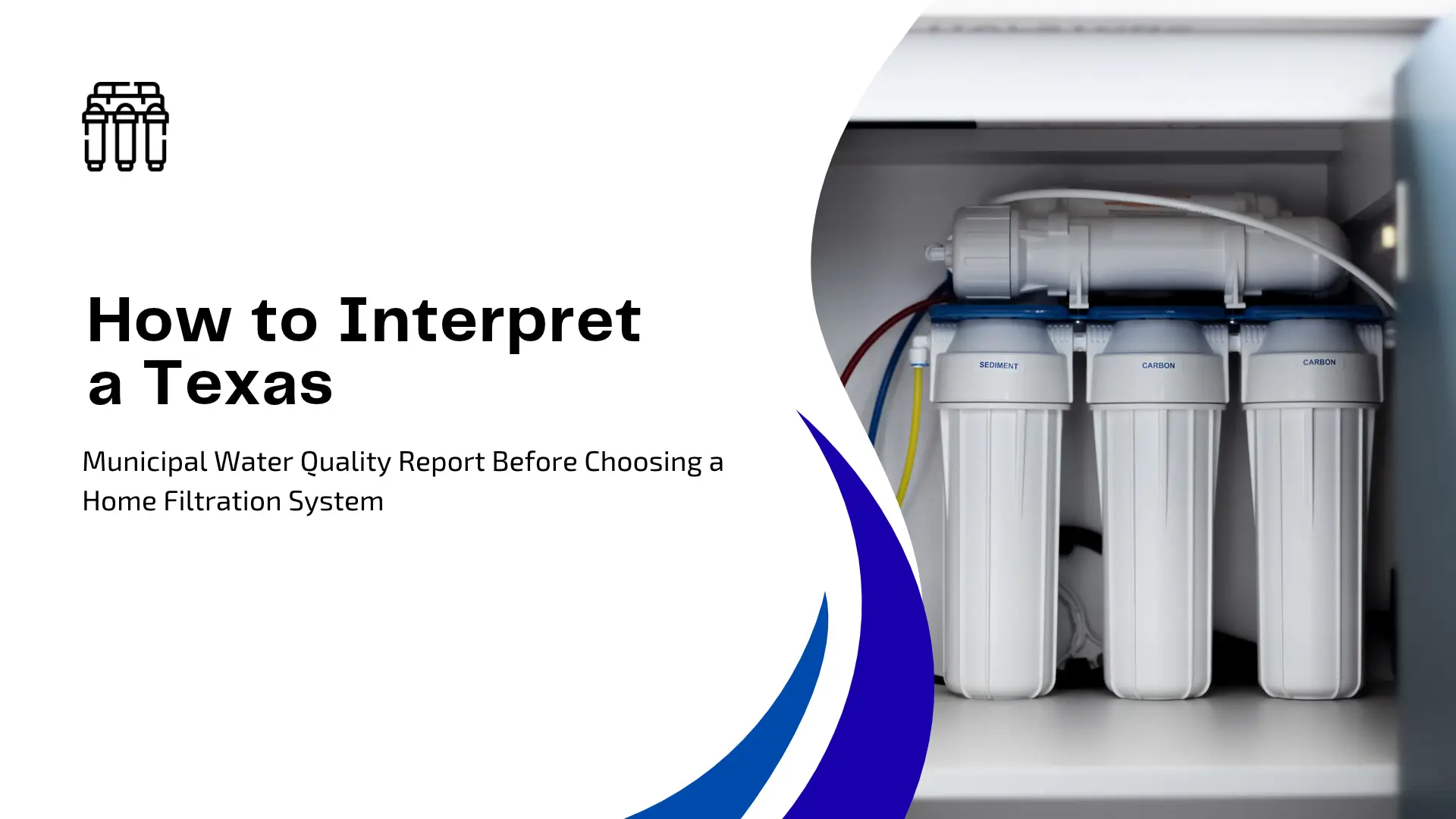
If you’re worried about lead, nitrates, or dissolved contaminants, reverse osmosis is the heavy hitter. RO forces water through a membrane that traps contaminants down to a very small size. It’s typically installed under the sink for drinking water rather than as a whole-home system, because it wastes water and is slow.
If you want everything addressed sediment, chlorine, hardness, and drinking water quality the common approach is a layered system: a whole-home carbon filter and softener for the house, plus an RO system at the kitchen sink for drinking and cooking.
Aqua Pure LLC, a Texas-based provider, handles all of these categories ofteners, whole-home filtration, RO, and sanitization and their team can look at your specific CCR data alongside a home assessment to recommend a setup that matches your actual water rather than a generic package.
A Note on Maintenance
Any system you install will need attention. Softeners need salt. Carbon filters need media replacement every few years. RO membranes and prefilters need changing on a schedule. If you’re not someone who wants to remember these things, ask about service plans or choose a system with clear, simple maintenance intervals. The best filtration system is the one that actually gets maintained.
Common Questions Texas Homeowners Ask
Is a whole-home water purification system worth it in Sugar Land or Katy?
It depends on what’s in your water and what bothers you. If you’re tired of hard water scale, chlorine smell, and replacing appliances prematurely, a whole-home setup can make sense. If your only concern is drinking water, a point-of-use RO might be enough. The CCR data gives you the starting point for that decision.
What water issues are most common in Texas homes?
Hardness is nearly universal. Chlorine or chloramine taste and odor are common. Sediment from aging infrastructure shows up in some areas. Lead is a concern primarily in older homes with older plumbing materials, not typically from the municipal supply itself.
Do water softeners remove contaminants?
No. Softeners remove hardness mineralscalcium and magnesium and that’s it. They don’t remove lead, nitrates, chlorine, or bacteria. Don’t let anyone tell you otherwise.
Is reverse osmosis safe for daily drinking?
Yes. RO systems produce high-quality drinking water. The main considerations are that they waste some water in the process and that they remove minerals along with contaminants some people choose to add trace minerals back, but that’s a personal preference, not a safety requirement.
How long do home water systems last?
Softeners can last 10–15 years with good maintenance. Carbon tanks and media typically need replacement every 3–5 years. RO membranes last 2–4 years depending on water quality and usage. The equipment itself is durable; the consumables are what you budget for.
A Final Word
Your water quality report is a tool, not a verdict. It tells you what your city is doing and what’s coming into your neighborhood. It doesn’t tell you what’s coming out of your tap. Use it to ask better questions, then get a professional assessment of your actual home.
If you’re in the Houston area, Sugar Land, Katy, or San Antonio and want help translating your report into a real plan, the team at Aqua Pure LLC works with Texas homeowners every day on exactly this. They can walk through your report with you and recommend a water softener system, a home water filtration system, or a reverse osmosis system based on what your water actually needs not a one-size-fits-all pitch.