


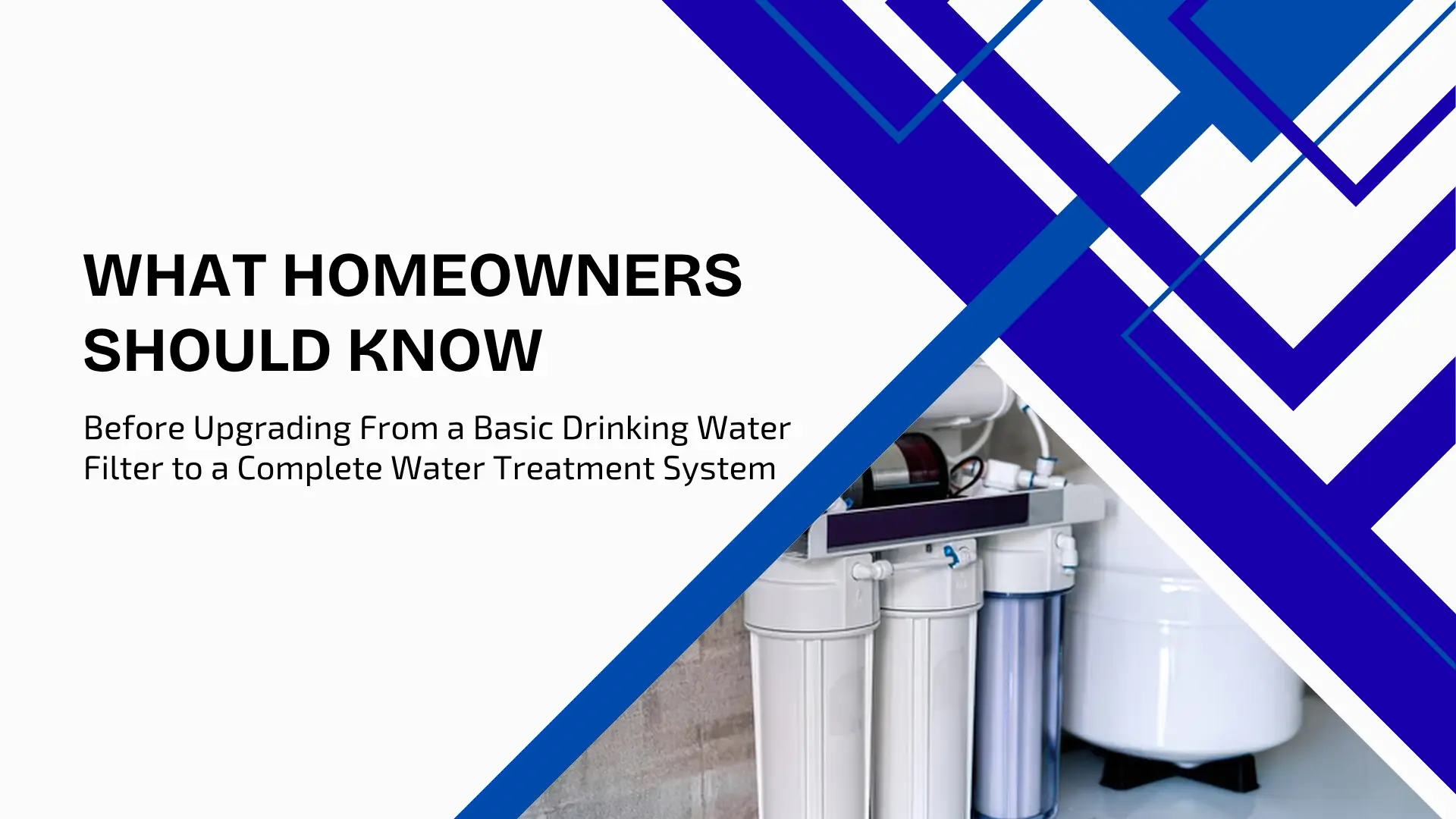
If you’ve been getting by with a pitcher filter in the fridge or a small under-sink unit, you’ve probably already taken the first step toward better water. But at some point, a lot of Texas homeowners start wondering whether that little filter is actually doing enough. Maybe the water still tastes a bit off. Maybe you’re scrubbing white crust off the showerhead every other week. Or maybe you just walked out of the shower and your skin feels tight and itchy in a way that doesn’t seem normal.
That’s usually the moment the question comes up: should I move from a basic drinking water filter to a complete whole-home water treatment system?
The honest answer is: it depends on what’s actually in your water and what you want to fix. This isn’t about selling you the biggest system on the market. It’s about understanding what each piece of equipment does, what it doesn’t do, and how to tell whether an upgrade makes sense for your house.
First, Let’s Talk About What a Basic Filter Actually Handles
A basic drinking water filter whether it’s a pitcher, a faucet mount, or an under-sink carbon blockis designed to do one main job well: improve the taste and smell of the water you drink and cook with. Carbon filters are genuinely good at pulling out chlorine and chloramine, which are the disinfectants that keep municipal water safe but can make it taste like a swimming pool . They can also grab some sediment and a handful of organic compounds.
What they don’t do is treat the water that hits your shower, your washing machine, your dishwasher, or your water heater. And in a lot of Texas homes, that’s where the real headaches live.
If you’re in Houston, Katy, Sugar Land, or anywhere along that stretch of West Houston, you’re likely dealing with water that’s not just chlorinated but also hardsometimes very hard. One regional breakdown puts Katy in the 10 to 14 grains per gallon range, which is squarely in the “very hard” category, with Sugar Land not far behind . San Antonio sits around 10.5 grains per gallon, which is hard enough to cause scale on fixtures and appliances as a regular complaint . That hardness doesn’t care about your drinking water filter. It’s flowing through every pipe in the house.
The Signs That Your Current Setup Is Falling Short
Before you start shopping for a whole-home system, it helps to get honest about what’s bothering you. Homeowners who end up happy with an upgrade usually checked several of these boxes first:
The taste is fixed, but everything else feels worse. Your drinking water might be fine, but your dishes come out spotty, your towels feel stiff, and your glass shower door has a permanent film. That’s hard water, and a drinking water filter will never touch it .
You’re seeing crusty buildup. White scale on faucets, showerheads, and the heating element in your kettle or coffee maker is the classic signature of calcium and magnesium. Over time, that same scale builds up inside your water heater and appliances, making them work harder and die younger .
Your skin and hair feel off. If you step out of the shower feeling dry and itchy, or your hair feels waxy no matter what shampoo you use, the minerals and chlorine in your water are likely part of the problem. A whole-home carbon filter can address the chlorine, and a softener can address the minerals.
You’re on well water. This is a different ballgame entirely. Well water in the Houston area and surrounding rural communities often carries high iron, manganese, sediment, and sometimes sulfur odors alongside extreme hardness . A basic drinking water filter is not designed to handle that kind of load, and you’ll need a system sized and configured for your specific water chemistry.
You’ve noticed sediment or discoloration. Rusty, cloudy, or sandy-looking water at the tap usually means something upstream is introducing particlesaging pipes, a well issue, or a municipal supply hiccup. Whole-home sediment filtration catches that before it reaches your fixtures.
Filtration, Softening, RO, and Sanitization: What’s Actually Different
This is where a lot of homeowners get confused, because the words get tossed around like they’re interchangeable. They’re not.
Filtration is about removing things from the water. That could be sediment, chlorine, organic chemicals, or even lead and other heavy metals depending on the filter media. A whole-home carbon filtration system treats all the water entering the house, addressing taste, odor, and chlorine at every tap . It’s not the same as softening.
Softening is about changing the chemistry of hard water. A water softener uses ion exchange to swap calcium and magnesium for sodium (or potassium), which stops scale from forming . Soft water doesn’t necessarily mean cleaner water in a health senseit means water that plays nicer with your plumbing and appliances. It’s worth knowing that softening does add a small amount of sodium to the water, which matters if you’re on a strict low-sodium diet .
Reverse osmosis (RO) is a point-of-use technology, usually installed under the kitchen sink, that pushes water through a membrane fine enough to remove dissolved contaminants like lead, arsenic, nitrates, and fluoride . It produces genuinely clean drinking water, but it’s not practical for whole-home use because it wastes a significant amount of wateroften several gallons for every gallon treated . Most homeowners pair an RO system for drinking and cooking with a whole-home filter and softener for everything else.
Sanitization (often UV) is about killing or inactivating bacteria and viruses. It’s essential for some well water situations but usually unnecessary for municipal water that’s already disinfected. If you’re on city water, you probably don’t need UV. If you’re on a private well with any microbial risk, it’s worth discussing with a specialist.
The key takeaway: these are different tools for different problems. A complete water treatment system often combines several of them in a specific ordersediment filter first, then carbon, then softener, then maybe RO at the kitchen tapso each stage does its job without being overwhelmed.
How a Whole-Home System Actually Works (Without the Jargon)
Think of it as a sequence of gates, each one catching something different.
Water comes in from the city line or your well. The first stage is usually a sediment filter that grabs sand, rust, and grit so the rest of the equipment doesn’t get clogged. Next comes carbon filtration, which handles chlorine, taste, and odor. If hardness is the issueand in most of South Central and Southeast Texas, it isthe water then passes through a softener that removes the scale-forming minerals.
From there, the treated water goes to your showers, sinks, laundry, and water heater. At the kitchen sink, you might have a dedicated RO system for drinking water, drawing from the already-treated supply so its membrane lasts longer.
The whole setup lives near where the main water line enters your housegarage, utility closet, or sometimes outside under a covered enclosure. A professional installation matters here, because a poorly sized or poorly sequenced system can create pressure problems or fail to deliver the results you’re paying for. If you’re in the San Antonio or Austin corridor, or up toward Dallas, the specific configuration should match your water source and hardness level. Aqua Pure LLC, a Texas-based provider, handles this kind of system design and installation regularly, and they’ll tell you straight whether you need all four stages or just two.
Maintenance: What You’re Signing Up For
Nobody loves this part, but it’s better to know now than to be surprised later.
Whole-home systems are not install-and-forget. Sediment and carbon cartridges need to be changed on a scheduletypically every six to twelve months depending on your water quality and usage. Softeners need salt replenished every few weeks to a couple of months, and the resin bed occasionally needs cleaning. RO membranes and filters need periodic replacement, usually annually or as water quality dictates. UV lamps, if you have one, need annual bulb changes.
The good news is that most of this is straightforward and can be handled by a homeowner who’s willing to keep an eye on things. Many modern systems have indicators or app reminders. The bigger point is that maintenance isn’t optionala neglected filter can become a breeding ground for bacteria, which is worse than having no filter at all .
If you’d rather not think about it, some companies offer service plans that handle the routine work. Aqua Pure’s customer service team can walk you through what a maintenance schedule looks like for your specific setup, and their service line is a real number you can call when something seems off.
The Long Game: What You’re Actually Protecting
The pitch for whole-home treatment often leans on comfortsofter skin, shinier hair, spot-free glasses. Those things are real, and they matter. But the practical case is about your house.
Hard water scale doesn’t just look ugly. It coats the inside of your water heater, reducing efficiency and shortening its life. It narrows pipes over time. It wears out washing machines and dishwashers faster than they should. One analysis of hard water costs puts the long-term damage in the thousands of dollars over a decade, between extra energy, premature appliance replacement, and all the extra soap and cleaning products you buy trying to compensate .
If you’re planning to stay in your home for a whileand most Texas homeowners aretreating the water is less of a luxury and more of a maintenance decision, like changing your HVAC filter or keeping up with your roof. You’re protecting the systems you’ve already paid for.
For homeowners in San Antonio dealing with that 10.5 gpg hardness, or in Katy and Sugar Land where it can climb higher, the math tends to favor getting the hardness under control sooner rather than later .
A Few Questions Homeowners Ask Before Making the Leap
Is a whole-home water purification system worth it in Texas?
For a lot of homeowners, yesespecially if you’re on well water or dealing with hard water that’s visibly affecting your fixtures and appliances. If you’re on good municipal water with low hardness and you’re only concerned about drinking water taste, a basic filter might genuinely be enough. The worth-it calculation depends on what you’re trying to solve. A water test is the only honest starting point.
What water issues are common in Texas homes?
Hardness is the big one across most of the state. Chlorine taste and odor are common in municipal supplies. Well water brings iron, sulfur, and sediment into the picture. Some areas see disinfection byproducts and trace contaminants in municipal reports, though public water is treated to meet safety standards . Older homes with lead pipes or fixtures may have additional concerns.
Do water softeners remove contaminants?
No. Softeners remove hardness mineralscalcium and magnesiumthrough ion exchange . They don’t remove lead, chlorine, bacteria, or most other contaminants. That’s why a complete system pairs softening with filtration. If you see a product claiming to soften and purify in one box, read the fine print carefully.
Is reverse osmosis safe for daily drinking?
Yes, RO water is safe to drink. It removes a wide range of dissolved contaminants . The main caveat is that it also removes beneficial minerals like calcium and magnesium, and some people choose to add a remineralization stage or make sure they’re getting those minerals from food. For most households, RO drinking water is a perfectly reasonable choice, especially if the alternative is water with elevated lead or nitrate levels.
How long do home water systems typically last?
It varies by component. Sediment and carbon filter housings can last many years; the media inside is what gets replaced. Softener resin beds typically last ten to fifteen years with proper maintenance. RO membranes usually need replacement every two to three years. The equipment itselftanks, valves, controllerscan last a decade or more if it’s sized correctly and not abused. Cheap, undersized systems tend to fail early.
A Final Word, and Where to Go Next
Upgrading from a basic drinking water filter to a whole-home system isn’t a small decision, and it shouldn’t be an impulse buy. Get your water tested. Figure out what’s actually in it. Talk to someone who can explain the results in plain language and recommend a system sized for your house, not a one-size-fits-all package.
If you’re in the Houston, Katy, Sugar Land, San Antonio, or Austin areas and you want a straight answer about what your water needs, the team at Aqua Pure LLC has been doing this work for Texas homeowners for years. They know the difference between West Houston hardness and Hill Country well water, and they’re not going to sell you a sanitizer you don’t need. A conversation and a water test is a reasonable place to startno pressure, just information.