


You’ve probably noticed itthat faint chlorine smell when you fill a glass from the kitchen tap. Or maybe you’ve seen the white crust building up around your faucets and showerheads. If you live anywhere near Sugar Land, Houston, or Katy, you already know Texas water brings its own set of challenges.
The real question most homeowners wrestle with isn’t whether to filter their water. It’s how much to filter.
Do you go all-in with a whole home filtration system, or do you tackle problems one faucet at a time with point-of-use solutions like reverse osmosis? Both have their place. But when you’re making a long-term investment in your home and family’s health, the answer depends heavily on where you live, what’s in your water, and how you actually use water every single day.
Let’s break this down Texas-styleno hype, no sales pitch, just practical guidance from someone who’s helped homeowners across the state figure this out.
What’s Actually Coming Out of Your Texas Faucet?
Before you can decide between whole home or point-of-use, you need to understand your enemy. Texas water isn’t the same everywhere, but certain problems show up again and again across Houston, Austin, Dallas, and San Antonio.
Most municipal water in Texas starts as surface water from lakes and rivers. That means it picks up sediment, agricultural runoff, and organic matter along the way. Your local water treatment plant does a solid job killing bacteria and virusesusually with chlorine or chloraminebut that leaves behind disinfection byproducts and that pool-water taste you’re probably tired of.
Then there’s the hardness problem. Texas sits on some seriously mineral-rich geology. Calcium and magnesium dissolve into the water supply as it travels through limestone and rock formations. That’s why so many homes in Katy and surrounding areas deal with scale buildup, soap scum, and appliances that seem to die young.
Lead can still show up too, even in cities with modern treatment. Old service lines and aging plumbing fixtures leach lead into water after it leaves the treatment plant. That’s a point-of-use problem that a whole house system won’t automatically solve unless it’s specifically designed for heavy metal reduction.
And here’s something most homeowners don’t realize: your water quality can change from one season to the next. Summer algae blooms in Lake Houston or Lake Travis mean your local plant might dump extra chlorine. Heavy rains stir up sediment. Drought concentrates minerals. Whatever system you choose needs to handle real-world variability.
Whole Home Filtration: The Heavy Lifter
A whole home water purification system does exactly what it sounds likeit treats every drop of water entering your house. Every shower, every load of laundry, every toilet flush, every glass of water from every sink. One system, one installation point where the main water line comes into your home.
For Texas homeowners dealing with hard water, sediment, and chlorine, whole home systems make a dramatic difference you can feel immediately.
What Whole Home Systems Actually Remove
A properly designed whole house water filtration system Houston residents rely on typically combines multiple stages. You’ll often see sediment filters that catch sand, rust, and dirt before they clog up your pipes and damage appliance valves. Then carbon filtration tackles chlorine, chloramine, and those musty, earthy tastes that come from algae byproducts.
If hard water is your primary complaintand for most of Texas, it isyou’re looking at a water softener paired with your filtration. Softeners use ion exchange to swap calcium and magnesium for sodium or potassium. That’s what stops the white scale on your fixtures, keeps your water heater running efficiently, and lets soap actually lather instead of turning into sticky curds.
Some whole home setups go further with UV sanitization for bacterial control, especially important for homes on well water or in areas prone to boil water notices.
The Real-Life Experience
Let me paint you a picture. You install a whole home system. The next morning, your shower feels completely different. Your skin doesn’t feel stripped and tight afterward. Your hair doesn’t have that weird crunchy texture. The glasses you wash come out spot-free without needing to dry them immediately.
That’s the whole home advantageit changes your experience of water throughout your entire house, not just at one sink.
For families with young children who take baths, for people with eczema or sensitive skin, for anyone tired of scrubbing mineral deposits off coffee makers and humidifiers, whole home filtration delivers lifestyle improvements that point-of-use systems simply cannot.
The Trade-Offs
Whole home systems cost more upfront. You’re paying for bigger equipment, professional installation, and often a dedicated space in your garage, utility room, or outside your home. Maintenance is straightforwardfilter changes every few months, salt refills for softenersbut it’s not zero.
You also need to understand what a basic whole home system won’t do. Standard carbon filtration and softening remove chlorine, sediment, and hardness minerals, but they don’t typically remove dissolved contaminants like lead, arsenic, nitrates, or pharmaceutical residues. For those, you need specialized media or a reverse osmosis stage.
Point-of-Use: Precision Treatment Where You Need It
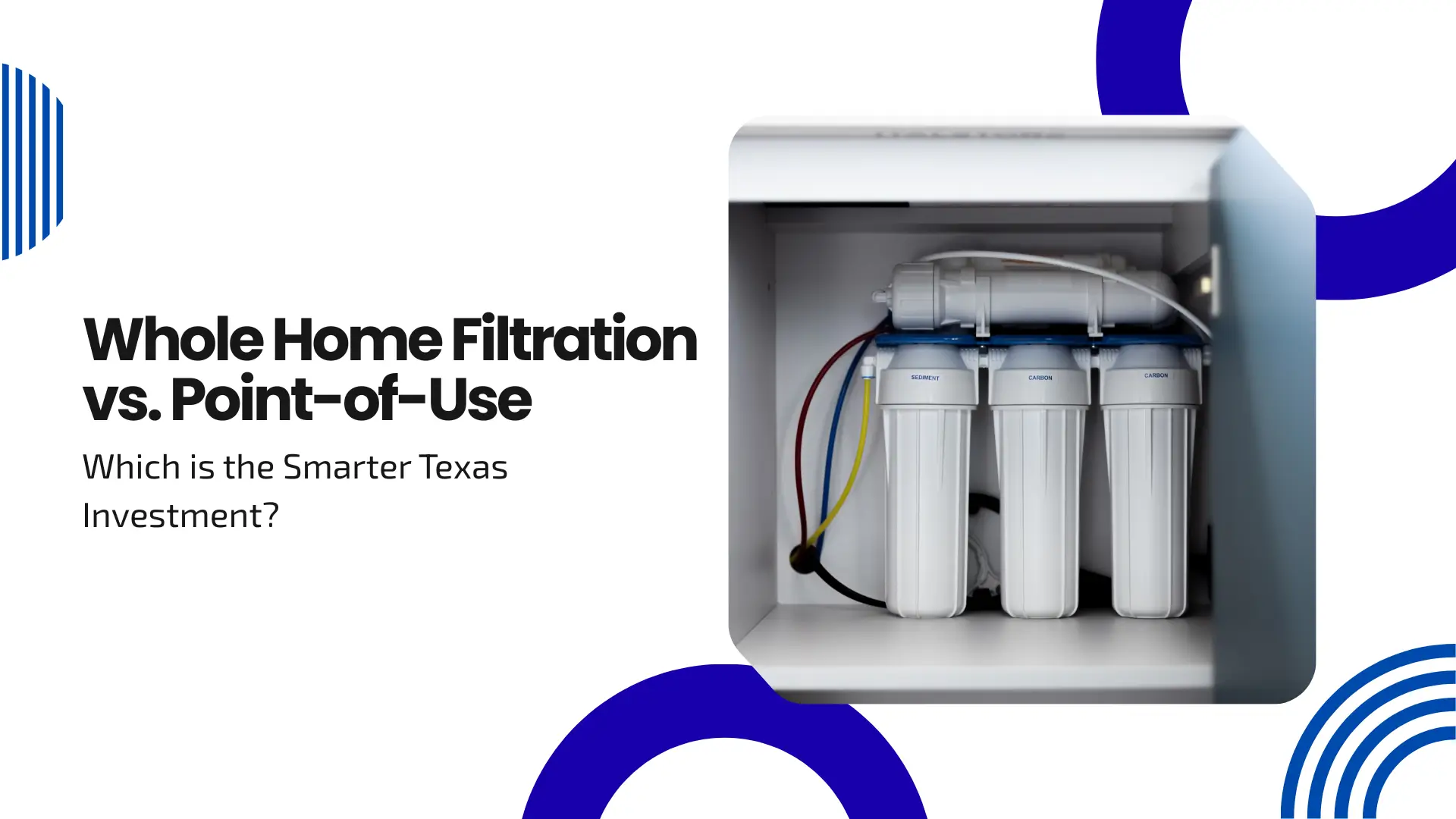
Point-of-use systems treat water at a specific faucetusually your kitchen sink, sometimes a bathroom vanity or a dedicated drinking water tap. The most common and effective option is reverse osmosis.
A reverse osmosis system pushes water through a semipermeable membrane so fine that it blocks nearly everything except pure H2O. We’re talking 95 to 99 percent reduction of lead, arsenic, nitrates, fluoride, chlorine byproducts, pharmaceuticals, and microplastics. RO water tastes incredibly clean because it is incredibly clean.
Where Point-of-Use Shines
If your primary concern is drinking water qualitynot shower water or laundry waterpoint-of-use makes excellent sense. You get pharmaceutical-grade purification at the one place you actually consume water from. The cost is much lower than whole home systems, installation is simpler, and replacement filters are affordable.
Many Texas homeowners use a hybrid approach: a water softener for the whole house to handle hardness and protect appliances, plus an under-sink reverse osmosis system for the kitchen tap. That gives you the best of both worlds without paying for whole home reverse osmosis, which can be overkill and extremely expensive.
The Limitations
Point-of-use systems only treat one location. Your shower water remains unchanged. Your washing machine still gets hard water. The ice maker in your refrigerator? Still untreated unless it has its own filter. You’ll also deal with slower flow rates from RO systemsfilling a large pot can feel like watching paint dry.
There’s also the wastewater consideration. Traditional reverse osmosis systems send two to four gallons of water down the drain for every gallon they produce. Newer high-efficiency models are better, but it’s still something to think about if you’re water-conscious.
Which One Is Smarter for Texas Homeowners?
Here’s the honest answer: most Texas homes benefit from both, but if you can only choose one, whole home filtration is usually the smarter long-term investment.
Here’s why.
Hard water damage is expensive and cumulative. Every time you run your dishwasher, wash a load of laundry, or heat water in your tank, scale is building up inside your appliances. That water heater that should last twelve years starts leaking at eight. Those dishwasher heating elements burn out. Your clothes come out stiff and faded because mineral deposits trap detergent against the fibers.
A water softener paired with whole home filtration prevents that damage before it starts. You’re not just improving water qualityyou’re protecting some of the most expensive systems in your home.
That said, whole home filtration alone won’t give you the ultra-pure drinking water that many families want, especially if you’re concerned about lead, arsenic, or agricultural runoff common in parts of Texas. That’s where adding a reverse osmosis system under your kitchen sink completes the picture.
For homeowners in Austin, Dallas, San Antonio, or Houston, the smart money is on a whole house water filter system that includes softening and carbon filtration, plus a dedicated reverse osmosis drinking water system at the kitchen sink. It’s the combination that addresses every real concernappliance protection, bathing water quality, and drinking water purity.
Signs Your Home Needs Water Purification Right Now
Not sure where you stand? Here’s what to look for around your house:
- White, crusty buildup on faucets, showerheads, and inside your kettle
- Soap that doesn’t lather well, no matter how much you use
- Dry, itchy skin and dull, brittle hair after showering
- Dishes that come out of the dishwasher with spots or film
- A noticeable chlorine taste or smell in drinking water
- Low water pressure from mineral buildup inside pipes
- Appliances that seem to fail earlier than expected
If you’re seeing three or more of these, your home is sending you a message.
Industry FAQ: Your Water Filtration Questions Answered
Is a whole-home water purification system worth it in Houston?
For most Houston homeowners, yes. Houston’s surface water sources pick up sediment and organic material, and the chlorine levels needed to treat that water can be aggressive. A whole home system removes that chlorine before it hits your shower and taps, plus it protects your plumbing and appliances from scale. The improvement in bathing water alone convinces most people they made the right choice.
What water issues are most common in Texas homes?
Hard water tops the list across the state. Chlorine and chloramine come in second, especially in cities using surface water. Sediment is common in areas with older pipes or during seasonal changes. Lead can appear in older homes with pre-1986 plumbing. In agricultural regions, nitrates from fertilizer runoff sometimes show up in well water.
Do water softeners remove contaminants?
No, and this is a critical distinction. Water softeners remove hardness mineralscalcium and magnesium. They do not remove chlorine, lead, arsenic, pesticides, or bacteria. That’s why softeners are almost always paired with carbon filtration or reverse osmosis for complete treatment. A softener makes your water feel better; filtration makes it safer.
Is reverse osmosis safe for daily drinking?
Absolutely. Reverse osmosis is one of the most thoroughly tested and trusted water purification methods available. It removes harmful contaminants while leaving you with clean, great-tasting water. The misconception that RO water is “too pure” or leaches minerals from your body isn’t supported by evidence. You get plenty of minerals from food. What you don’t want is lead or arsenic in your drinking glass.
How long do home water systems typically last?
A quality whole house water filtration system Houston homeowners install should last ten to fifteen years with proper maintenance. The filtration tanks themselves are durable, but the media inside needs replacement every few years depending on your water quality and usage. Reverse osmosis systems typically last ten to twelve years for the tank and faucet, with membrane replacements every two to three years. Water softener tanks can last fifteen to twenty years, though the control valve may need service around the ten-year mark.
Making Your Final Decision
Here’s my take after helping homeowners across Texas sort through this decision.
If you own your home and plan to stay there for more than a couple of years, invest in whole home filtration with a softener. Protect your pipes, your water heater, your dishwasher, and your washing machine. Improve every shower, every load of laundry, every time you wash your hands. Then add a reverse osmosis system under your kitchen sink for drinking water.
If you’re renting or on a tight budget, start with a good point-of-use reverse osmosis system for your kitchen. You’ll have clean drinking water, which covers your most immediate health concern. Save the whole home investment for when you buy or when your budget allows.
If you’re somewhere in between, consider whole home filtration for sediment and chlorine onlyskip the softener temporarilyand add the softener later when you can.
The right answer depends on your specific water, your home’s plumbing, and your family’s needs. That’s why working with experienced local professionals matters. Companies like Aqua Pure LLC have been helping Texas homeowners navigate these exact decisions for years, with certified specialists who understand local water conditions from Sugar Land to Katy to Houston and beyond.
They offer whole home systems, reverse osmosis, water softeners, and UV sanitizationplus professional installation that ensures your system actually performs as designed. A system is only as good as its installation, and Texas water deserves someone who knows what they’re doing.
If you’re ready to stop guessing about your water quality, reach out to Aqua Pure LLC. They’ll test your water, explain your options in plain English, and help you make the investment that makes sense for your home and your budget.
Your water shouldn’t be a source of stress. Whether you go whole home, point-of-use, or both, the important thing is taking that first step toward better water. Your appliances, your skin, and your family will thank you.